

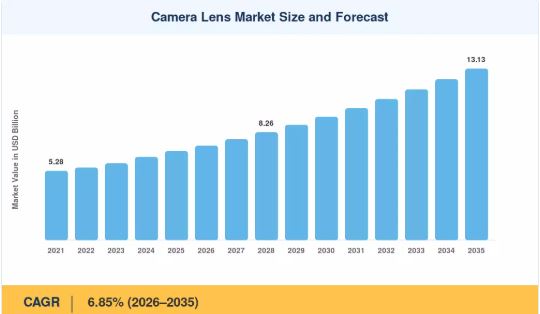
Global Camera Lens Market Expected to Reach USD 13.13 Billion by 2035, Registering 6.85% CAGR
Camera Lens Market
Camera Lens Market Size, Share and Research Report By Type (Digital Camera Lenses, Smartphone Camera Lenses, Action Camera Lenses, Mirrorless Camera Lenses)
Camera Lens Market is growing with rising demand for high-resolution imaging across smartphones, automotive systems, surveillance, and professional photography.”
NEW YORK,, NY, UNITED STATES, August 27, 2026 /EINPresswire.com/ -- The Global Camera Lens market was valued at USD 6.80 billion in 2025 and is projected to open the forecast window at USD 7.23 billion in 2026, reaching USD 13.13 billion by 2035 at a 6.85% CAGR. Two catalysts anchor that trajectory. India's Electronics Component Manufacturing Scheme, notified in April 2025 with an INR 22,919 crore outlay, explicitly names camera module sub-assemblies as a priority category, and the first tranche of seven approvals in October 2025 committed INR 5,532 crore. — Market Research Future (MRFR)
Alongside it, the European Union's General Safety Regulation (EU) 2019/2144 became binding on all new vehicle registrations from 7 July 2024, hard-wiring multi-camera perception into every passenger car sold in the bloc. The market's 6.85% CAGR reflects the convergence of ADAS regulatory mandates (+1.55% impact), multi-camera handset architectures (+1.40%), industrial machine vision deployment (+1.10%), and government component manufacturing incentives (+0.85%) accelerating across the world's largest automotive-safety and consumer-electronics economies simultaneously.
➤ Smartphone Camera Lens Innovation:
The Smartphone Camera Lens segment represents a major area of innovation as consumers increasingly expect professional-quality photography and video capabilities from mobile devices. Smartphone manufacturers are incorporating multi-camera configurations, telephoto lenses, ultra-wide-angle optics, macro capabilities, and advanced optical stabilization to improve imaging performance. At the same time, lens manufacturers are focusing on compact optical structures that can accommodate sophisticated camera systems without significantly increasing smartphone thickness.
Get Full PDF Sample Copy of Report: (Including Full TOC, List of Tables & Figures, Chart) @
https://www.marketresearchfuture.com/sample_request/43035
➤ How Significant Is the Camera Lens Market's Growth?
The camera lens market's trajectory from USD 6.80 billion in 2025 to a projected USD 13.13 billion by 2035 represents nearly a two-fold expansion over the forecast decade, reflecting the structural shift from fixed-aperture, spherical-element assemblies toward folded periscope stacks, moulded aspheric arrays, and inference-grade optics deployed across handsets, vehicles, and industrial inspection lines. The market's 6.85% CAGR is anchored in a regulation-and-optical-content supercycle where ADAS mandates, multi-camera smartphone architectures, and machine vision inference are all converging to make precision optics a structurally growing category even as headline device shipments flatten.
Standard and prime lenses retained a 52.0% share of the market in 2025, reflecting entrenched kit-lens attach rates, while periscope, or folded optics, lenses are advancing at a 12.1% CAGR through 2035, the fastest of any lens type, as folding the optical path across a prism delivers 5x native reach without increasing chassis thickness. Consumer electronics generated USD 4.22 billion in 2025 within the market, though industrial and machine vision applications are expanding at an 11.0% CAGR to 2035 as inference-based inspection displaces rule-based stations and specifies higher-resolution optics. Mirrorless mounts now anchor the mount category at 57.6% share as interchangeable lens shipments reached 10.31 million units in 2024, up 107.0% year-on-year, while OEM and module suppliers are the fastest-growing end-user segment at a 12.6% CAGR, propelled by handset and automotive integration standards.
➤ What Does the Future Hold for the Camera Lens Market?
ADAS regulatory mandates contribute approximately 1.55 percentage points to the camera lens market's CAGR the single highest driver impact. Regulation (EU) 2019/2144 applied to all newly registered vehicles from 7 July 2024, requiring reversing detection, driver drowsiness warning, and intelligent speed assistance, capabilities that in practice demand three to eight camera positions per vehicle. In the United States, FMVSS 111 has required rear visibility systems on all light vehicles under 10,000 lbs since May 2018. Each mandated position carries a lens assembly rated for AEC-Q102 thermal cycling, which raises unit content well above consumer averages and gives the market an unusually stable regulatory floor.
Multi-camera handset architectures contribute approximately 1.40 percentage points to the CAGR, establishing optical content growth as a primary structural driver even as smartphone unit shipments have flattened. Sunny Optical's premium six-plastic-element-and-above lens shipments grew 11.5% year-on-year in 2024, and periscope plus large-image-size modules rose 27.5% to roughly 24 million units, with the tetraprism approach adopted at the flagship tier in late 2023 since cascading into upper mid-range devices across Chinese OEM portfolios.
Industrial machine vision deployment adds a further 1.10% as inference models degrade sharply on chromatic aberration and edge softness, prompting integrators to specify low-distortion telecentric and fixed-focal designs rated above 12 megapixels where 5 megapixels once sufficed, with global industrial robot installations holding above 500,000 units annually since 2021 and each vision-guided cell typically carrying two to six lens assemblies. Government component manufacturing incentives contribute a further 0.85% as India's Electronics Component Manufacturing Scheme had attracted investment commitments near INR 1.15 lakh crore by December 2025, roughly double the original target.
The next phase of the market's evolution centers on inference-grade optics rewriting specification norms, as edge neural processing changes what good enough optics means models trained on clean imagery degrade unpredictably when fed soft-cornered or aberrated frames, pushing system architects to specify tighter MTF thresholds even as sensor sizes shrink, bifurcating the market between commodity assemblies and inference-grade optics carrying published, traceable optical performance data.
Mount ecosystems are also behaving like software platforms, with major manufacturers licensing their mirrorless mounts to independent optical houses to expand lens catalogues without capital outlay while locking bodies into the ecosystem, a dynamic expected to accelerate through 2030 with royalty structures becoming a disclosed revenue line. Per-vehicle camera counts are projected to rise from roughly five today toward eleven in Level 3-capable architectures, with Sunny Optical's automotive order book alone standing near RMB 15 billion in 2025, while rare-earth-bearing optical glass faces tightening scrutiny under EU circular economy rules, positioning suppliers who establish closed-loop glass recovery to convert a compliance cost into a raw material hedge.
Get access to the full description of the report @
https://www.marketresearchfuture.com/reports/camera-lens-market-43035
➤ Who Are the Key Players in the Camera Lens Market?
MRFR identifies the following key participants:
• Sunny Optical
• Largan Precision
• Canon
• Sony
• Nikon
• Fujifilm
• Zeiss
• HOYA
• Tamron
• Genius Electronic Optical
• Sigma
• Kowa
Strategic competition in the camera lens market is increasingly defined by precision moulding tolerance and coating chemistry rather than optical formula, with optical-grade glass and rare-earth input volatility cited as a top structural headwind, as high-refractive-index optical glass depends on oxides of lanthanum, gadolinium, and niobium concentrated in a restricted supply base where price moves exceeding 20% squeeze mid-tier lens houses lacking hedging volume, alongside DSLR installed-base decline, computational imaging substitution that limits ASP growth in the mass consumer tier, export controls and entity-list restrictions, and precision moulding capacity bottlenecks.
➤ What Are the Emerging Trends in the Camera Lens Market?
Several transformational trends are redefining the camera lens market's evolution through 2035:
Automotive Sensor Cleaning and Heated Optics: Reliability of perception in snow, fog, and road spray is a functional safety necessity, positioning integrated heating components, hydrophobic surface treatments, and ultrasonic cleaning as a premium sub-segment where content value can be three to four times that of a regular external lens.
India and Southeast Asia as a Second Optical Cluster: Seven ECMS projects worth INR 5,532 crore were cleared in October 2025, with camera module sub-assemblies among the approved categories, while Vietnam has absorbed parallel module investment, opening a genuine dual-sourcing option outside the Pearl River Delta for the first time in a decade.
Optics-as-a-Specification for Machine Vision Integrators: Vision system integrators increasingly want validated lens-sensor-illumination bundles rather than components, with suppliers who publish MTF curves, distortion maps, and thermal drift data capturing design-in earlier and defending against commodity substitution through recurring calibration and validation services.
Surveillance Refresh in Gulf Infrastructure Programmes: Large-scale urban programmes across Saudi Arabia and the UAE embed perimeter and traffic monitoring at design stage, with varifocal lenses dominating tenders because a single SKU covers multiple mounting geometries, creating an unusually specification-driven demand pool less price-sensitive than consumer channels.
Smart Eyewear and Pass-Through Optics: Lightweight AR devices demand freeform and pancake optical elements at thicknesses conventional grinding cannot reach, with wafer-level and nano-imprint processes approaching cost parity, positioning suppliers investing in those lines now for volumes that arrive after 2030.
Buy Full Research Report:
https://www.marketresearchfuture.com/checkout?currency=one_user-USD&report_id=43035
➤ How Is the Camera Lens Market Segmented?
The camera lens market report provides a comprehensive segmentation framework:
By Application: Consumer Electronics (62.0% share, 2025), Automotive (USD 1.09 billion, 2025), Security & Surveillance (11.0% share, 2025), Industrial & Machine Vision (11.0% CAGR), Medical & Scientific (8.4% CAGR), Others (1.0% share, 2025)
By Lens Type: Standard & Prime (52.0% share, 2025), Wide-Angle & Ultra-Wide (USD 1.22 billion, 2025), Telephoto & Super-Telephoto (7.9% CAGR), Periscope / Folded Optics (12.1% CAGR), Macro (5.0% share, 2025), Fisheye & Specialty (3.0% share, 2025)
By Mount and Compatibility: Mirrorless Mount (57.6% share, 2025), DSLR Mount (22.4% share, 2025), Fixed / Integrated Mount (USD 0.97 billion, 2025), Cinema / PL Mount (6.8% CAGR), Industrial C/CS/F Mount (9.9% CAGR)
By End-User: Professional (47.0% share, 2025), Consumer / Enthusiast (USD 1.90 billion, 2025), OEM & Module Suppliers (12.6% CAGR), Institutional / Government (8.0% share, 2025)
By Focal Length: Ultra-Wide, under 16 mm (11.2% CAGR), Wide, 16-35 mm (38.5% share, 2025), Standard, 36-70 mm (USD 1.80 billion, 2025), Telephoto, 71-300 mm (16.0% share, 2025), Super-Telephoto, over 300 mm (6.7% CAGR)
By Material: Glass, Plastic, Composite
By Region: Asia-Pacific (66.0% share, 2025), North America (USD 0.99 billion, 2025), Europe (13.0% share, 2025), South America (6.2% CAGR), Middle East & Africa (7.0% CAGR)
➤ What Are the Regional Insights from the Camera Lens Market?
Asia-Pacific dominance in the camera lens market, at 66.0% of 2025 revenue, rests on vertical integration that no other region matches.
North America generated USD 0.99 billion in the camera lens market in 2025, with demand here specification-led rather than volume-led.
European demand in the camera lens market, holding close to 13.0% share, is regulation-shaped. The General Safety Regulation's full application from July 2024 lifted per-vehicle camera counts across every segment, and Euro NCAP's rating protocols push manufacturers beyond the legal minimum to protect star ratings.
Germany commands 24.0% of regional share through automotive ADAS and industrial inspection, with the country's Mittelstand machine builders forming a second, quieter demand base for high-precision fixed-focal optics.
Growth in South America and the Middle East & Africa tracks public security budgets more closely than consumer electronics cycles.
➤➤➤ Industry Analysis Reports by Market Research Future:
Embedded Systems Market
https://www.marketresearchfuture.com/reports/embedded-systems-market-8663
Non-Destructive Testing Services Market
https://www.marketresearchfuture.com/reports/non-destructive-testing-services-market-5580
Refurbished Electronics Market
https://www.marketresearchfuture.com/reports/refurbished-electronics-market-12333
Ai In Video Surveillance Market
https://www.marketresearchfuture.com/reports/ai-in-video-surveillance-market-12476
Photoresist Market
https://www.marketresearchfuture.com/reports/photoresist-market-17758
India Sensors Market
https://www.marketresearchfuture.com/reports/india-sensors-market-20718
India Vertical Farming Market
https://www.marketresearchfuture.com/reports/india-vertical-farming-market-20715
Ai In Insurance Market
https://www.marketresearchfuture.com/reports/ai-in-insurance-market-8465
Digital Banking Market
https://www.marketresearchfuture.com/reports/digital-banking-market-1986
Asset Backed Securities Market
https://www.marketresearchfuture.com/reports/asset-backed-securities-market-23890
Market Research Future
Market Research Future
+ +1 855-661-4441
email us here
Legal Disclaimer:
EIN Presswire provides this news content "as is" without warranty of any kind. We do not accept any responsibility or liability for the accuracy, content, images, videos, licenses, completeness, legality, or reliability of the information contained in this article. If you have any complaints or copyright issues related to this article, kindly contact the author above.
